 martinfabian.sk
A few days ago I published my longest fencing video yet. As its name suggests it’s part I in a two-parter series dealing with the complete work of a master known as Hans Medel of Salzburg. Due to the format of the video and my goal not to make it overly long, not everything could be disclosed. This article serves the purpose to add a few remarks to some of the techniques shown and the video in general.
About technical videos
It’s my impression that technical showcases from manuscripts and renaissance prints peaked in the 2010s. Nowadays when most stuff of this kind is figured out, they are rarer. Their significance and aim has changed as has their understanding. For anyone watching a technical demo in 2026 I believe the majority of people understand what’s being demonstrated and that it doesn’t have to be the fastest, super action packed. Fencers can read intentions, technical nuances and potential applications because many of us simply have now the experience of applying historical techniques in sparring and tournaments.
But just in case you’re new to this: This video tries to demonstrate every single technique described in the manuscript known as Hans Medel’s Fechtbuch (or Cod.I.6.2º.5). This is a unique source which differs from other books of similar origin (meaning Lichtenauer lore). What I’m showing in it are actual late medieval (or early renaissance) fencing techniques. Their application comes from extensive experience as fencers and it differs from something that would be more akin to stage combat or film. Its purpose is not to cause awe and theatrics, but rather options of how these techniques should be applied. All people who fence in this video have years of experience and they know what to do or how most things turn out in reality. In order to showcase we needed to cooperate; naturally the ‘reality’ of fencing is far more complex, therefore try to see the video more as an inspiration which works best paired with reading the original text. Sometimes we need to exaggerate, sometimes we need to slow down in some passages… Things are shown like they are shown on purpose.
Briefly about difficulties with Medel
The commentary which the author often attributes to a certain Hans Medel is absolutely unique between surviving fencing books. However traces of it or of something we can call an ‘alternative tradition’ can be found in many other books, including notable works like HS3227a, Liegnitzer, Talhoffer, Cluny, Wilhalm, Mair and others. The commentary is not finished and misses the primary description of 6 important techniques. Luckily, most of these can be cross-referenced between the author’s original teaching called the Seven Stances and the content of the Zettel commentary itself.
Still, due to many changes (starting with the taxonomy of positions), interpreting Medel takes a lot of brainpower. It would be nigh to impossible to fully understand it without looking at other works and having a relatively extensive knowledge and experience in fencing.
On the reliability of interpretations
Even though I tried my absolute best and I’m fairly confident about most of the techniques in the video, it’s possible that with time some of the interpretations will change and develop (or somebody will figure out things better than me). I will discuss some of my uncertainties and rationales below so my fellow researchers can see why I landed with this or that decision. I originally wanted to apply a confidence meter in the video, however that would only make it unnecessarily confusing for the general public.
Despite confidence or hesitation one of the best things you can do is to not agree with me. Whether anyone of us is right or wrong, an open discussion is what this source would benefit from the most. To be honest I expected some after I published the book and popularized Medel to the broader audiences, but most of it is coming in very slowly. On the other hand I realize how difficult Medel is and that more time will be needed for fencers to familiarize themselves with him. Or perhaps this work is doomed to be a forever outsider despite its immense value. Only time will tell! 🙂
To my absolutely positive surprise, one of the best current practical interpreters Zachary Brown from Superior HEMA launched a video series on explaining the Zettel from POV of Medel. The production value is very high, the explanations are clear. I’m looking forward to the next installments (there are 5 out at the time of writing of this article).
Notes on particular interpretations
I won’t go into every single technique. Most of them are super clear even in their description and I don’t think there is much to discuss. See the ones I deem controversial or perhaps problematic or curious by their order of appearance below. Just to be sure – this is not a walkthrough how to perform techniques. These are my notes which will be helpful if you’ve read Medel and have some questions on your mind. If the need arises, I’ll edit this article at some point to add more.
Position – Flech / Alber / Scheitler (1:02)
- I showcase a relatively horizontal hold, though in the video I jump between various versions of the position
- I do not think there’s one way to hold it, even Medel (apart from the main description) uses multiple versions
- The way how we hold it influences how we break it with versetzen – we cannot use the same way of executing a twir for example against a more roof-like version or a horizontal version; also, a ‘kurtz haw’ execution changes dramatically

Position – Vomtag (1:09)
- This relatively weird position makes the most sense – it’s depicted in many sources including Cluny, Wilhalm or even Talhoffer
- Since Medel’s schielhaw and some other things counter Medel’s vomtag, there is no way it would work with a retracted blade
- You can see how we use it throughout the video or in some of my older videos. I tend to call this guard “high langort”, but let’s stay with Medel and vomtag

Position – Zornhaw (1:17)
- Medel doesn’t really discuss a position like that, however I’m pretty sure it existed in a similar fashion like schielhaw, scheitelhaw, mittelhaw… etc. At the end of the day, other authors related to Medel’s work talk about it (see the example from Wilhalm above)
- I thought it’s important for general public to differentiate between a wrathful oberhaw and a technical vomtag position which allows for slightly different work
- This applies for any position – the ultimate way how you hold it doesn’t matter; if you prefer to drop the tip further behind your back, be my guest. What matters is the goal or intent – to throw a strong oberhaw
Medel Abnehmen (2:17)
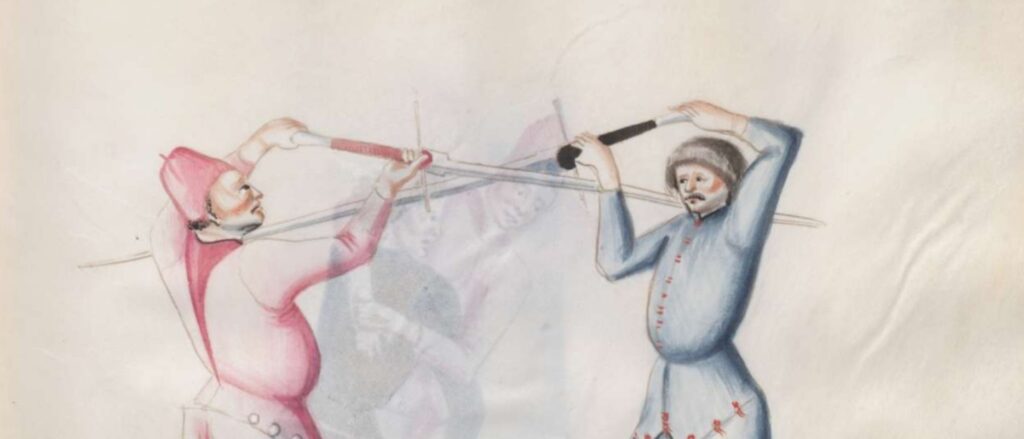
- During the initial readings of the text you may get the impression the abnehmen is done similarly as the traditional abnehmen – we take it up and cut back, however with the short edge
- This is not supported by any of the following techniques and doesn’t sit well with Medel’s logic of ‘krumphaw everywhere’
- Furthermore this action is clearly depicted in one of the illustrations in the book (picture 2)
- Whether you cut it more vertically or horizontally is a technical and situational preference
Strike from being hard in the bind (4:40)
- Both a direct winden/duplieren and a double tap sit well with the description and I don’t think it has any significant influence on anything that comes further, so feel free to interpret it as you like
Mutieren (A+B, 5:15)
- Besides sprechfenster, the mutieren was perhaps the biggest riddle for me
- The thing is the way how it’s written in the original makes the interpretation very difficult and I’m being generous by using the word ‘very’
- My process was simple
1. Go through all of Medel and build a rough interpretation of the work
2. Revisit a particular technique with overall idea of how Medel works
3. Make a deeper research of details of individual technique by finding every mention of the stück in the manuscript, fitting interpretation on every mention, looking for references in other aforementioned complementary works etc. - For Mutieren I compiled a small document I went through every now and then
- Shooting the video made me revisit my translation in the book. With my current knowledge I would slightly rewrite it because I think I understand a little better what the author meant (he’s very chaotic in the main mutieren text).
- The book version:
“Mutieren you do as follows: the moment your opponent wanted to cut you to the other side, you made the upper dupplieren and broke his opening etc., as it says above. However, if he doesn‘t want to cut from there to the other side, you shouldn‘t go away from the bind, as it says above. In that case, let your tip go between the two of you and hit him in the other opening on the right side of his head. If he‘s cutting you from the aforementioned attack or bind into the lower opening, then turn your sword or tip from there so that it‘s pointing downwards. This will break all his openings. He won‘t know ahead of time where he‘ll be safe and won‘t be able to move into the attack…”
- Revised version:
“Mutieren you do as follows: the moment your opponent wanted to cut you to the other side, you made the upper dupplieren and broke his opening etc.,. However, if he doesn‘t want to cut from there to the other side, you shouldn’t go away between the two of you. But (if he’s indeed cutting to the other side as you made the upper dupplieren) then let your tip swiftly go between the two of you and hit him into the other opening on his head on his right side. If he‘s cutting you from the aforementioned attack or bind into the lower opening, then turn your sword or tip from there so that it‘s pointing downwards. This will break all his openings. He won‘t know ahead of time where he‘ll be safe and won‘t be able to move into the attack…”
- The primary reason for confusion are the chaotic and lacking usages and descriptions of mutieren and the vocabulary and the weird insertion about ‘not going anywhere’
- In order to fit this description we are then left with not many options how to perform a mutieren together with duplieren, mainly if we want to remain practical and within Medel’s logic
- Another passage which confirms this can be found in the Zornhaw “Counterattack against lifting up:” part and says:
“If someone lifts a sword and cuts you on the other side, then bind yourself or put the sword with the short edge to his ears (i.e., perform winding) strongly. You can do it either way, it‘s called dupplieren or mutieren.”
- The only way how to do it safely and fitting with all instances in the text is demonstrated in both versions
- The main differentiator between them is the attack that flies towards us. One version works better against regular/direct cuts, the other works better against twirs/krumps.
- Perhaps a completely different optic should be used for this but it eludes me now. Again, time will tell. Still, my confidence with this is about 80% I’d say.
- The other ‘conservative’ options I show are there mainly to show you my other thought processes… maybe you’ll find something in it, who knows.
- And just a sidenote: After this I’ve started looking at Kal’s illustrations very differently, but that’s a topic for another day
Kurtzhaw (10:28)
- I show multiple versions because with some angles it’s impossible or reckless to attack the head unless you risk and ignore the threat which I wouldn’t do in this particular instance
Twirhaw versetzen (11:19)
- Similar to kurtzhaw above, there are sometimes multiple versions depending on angles of targeted positions. I see no problem with that.
- I was also considering a kind of inverting into a krumphaw, but like with other things, it doesn’t really make much sense – and I think Medel would mention it

Verkehrer (16:04)
- I use the classical Lichtenauer twist of the elbow. It’s not explicitly described here though the author sometimes implies traditional interpretations in other instances
- Even a push like we use in other examples would do (and perhaps would fit more)
- Choose what suits you the best
Schieler (19:12)
- Sometimes the author describes “the classical” (other masters’ version) schielhau, however it’s difficult to say with certainty if he really means the inverted cut we know, from the typical position where we launch it from. He just may point towards general principles (target blade, hit hands) rather than a specific inverted technique
- If he defined a starting position it would be easier to decipher
- Therefore I show all the different options. As before: Pick what suits you the most, I’m not sure we’ll ever know better
Schnappen against Schiel (22:20)
- Very vague description
- My confidence isn’t very high with both. I’d say with these I’m at 50%.
- At the end of the day, both may work.
- There’s one more alternative – moving the sword towards the other’s blade as if to strike it from below and then making the schnappen. I didn’t film that one but could be, who knows.
Scheitelhaw (23:38)
- I’m pretty sure that despite textual evidence (apart from I think one mention in the Seven Stances) the Scheitelhaw can be used from both sides
- Medel doesn’t discuss that and I want to stay within reasonable boundaries so I don’t show this version
Kron (25:04)
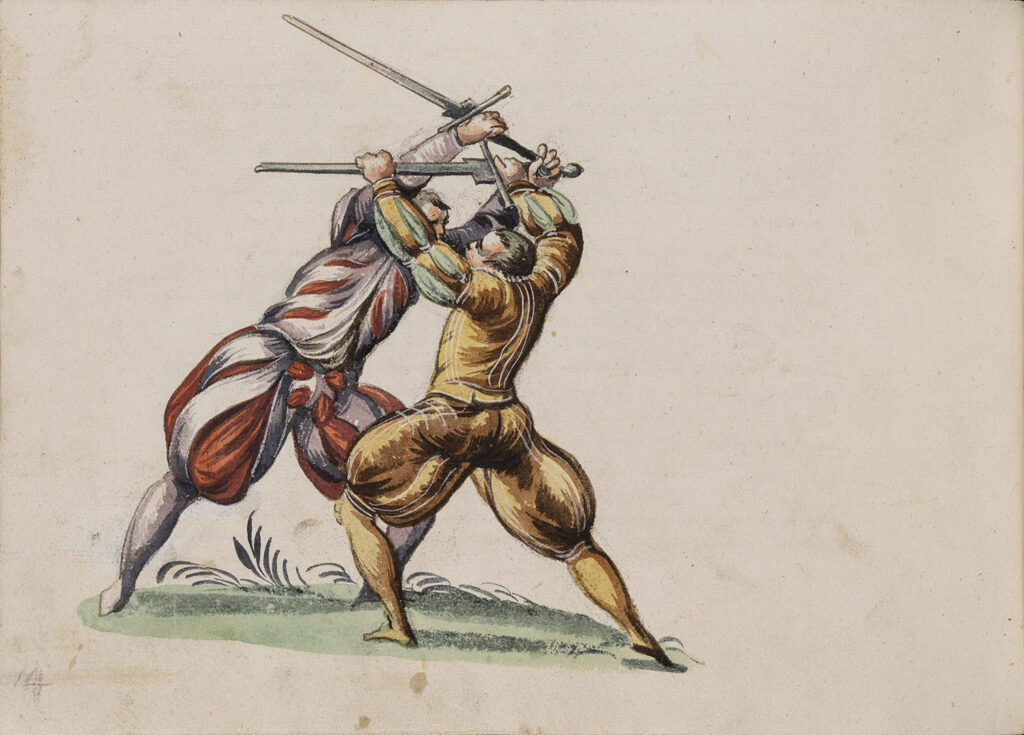
- I think the author should have made a better job in describing counters to Kron because some things are mechanically weird (mainly the crossguard throwing against regular Kron)
- I show two alternatives for fun pullings of the armed Kron. The first one (towards the dominant hand) can also work with counter-armed hold, like Meyer does in the picture above
Outer and inner mynnen (34:18)
- There’s only one thing I want to add to these techniques or rather a tactical approach; up to now I have not found a reliable translation of the term “mynn” or “nymm” (in some other books). I do think it’s somewhere on a scale from super simple < > unknown and lost phrases. I understand how it works, what to do with it etc, but I don’t know why Medel and others use this specific term. Perhaps one day the etymology will become clearer.
Cuts from below in nachreisen and uberlauffen (38:13)
- In the whole video we show the cuts from below exaggerated from large swings and preparations. On the other hand, the probability of people on fechtschulen really fenced like that is quite high. Meyer often uses Ochs as a starting point for his unterhawen and Medel talks about pronounced cuts, large swings and preparations in many places
- Uberlauffen and nachreisen can be done in many ways so if you want to let the lower cut pass first and then hit the opponent, feel free to do so
Absetzen – canonical (39:22)
- The canonical absetzen (meaning thrusting against thrusts) can be done with both edges, with the thumb up or down… the goal should dictate the means. The video shows all options. Personally I prefer to go as directly as possible (less turning means faster and precise).
And that’s about it. Part II will have less techniques but some more question marks and uncertainties. I will do my best to cover it correctly so Medel’s work is properly represented. Like I wrote before I really hope these videos will stir more conversations about interpretation. This alternative tradition of what I call ‘Medelism’ is so interesting it would be a shame if it were just a sidenote for most fencers because they can’t accept a different name for a position 🙂
Thanks for reading and thanks for watching the video!
If you have any questions or remarks regarding this topic, feel free to contact me on Facebook or through email at shop@martinfabian.sk.
Cheers
